
The Mushroom Matrix — Largest, Oldest, Most Bizarre Fungi
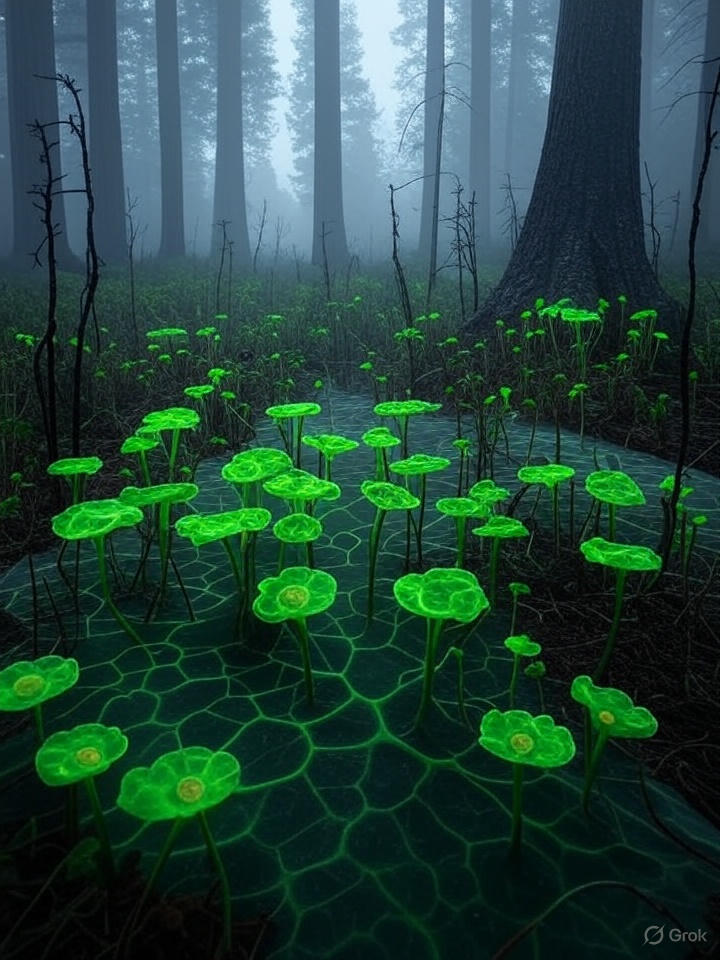
“Some spectacles, my dear friend, unfold not in gilded theaters but in the earth’s shadowed wilds, where fungi reign as ringmasters of a circus as bizarre as a Mongolian warlord’s fevered hallucination.”
Beneath an Oregon pine forest at dusk, where mist clings like a thief’s cloak, Armillaria ostoyae sprawls—Earth’s largest organism, its mycelial web stretching 2,385 acres, older than the pyramids. Nearby, Ophiocordyceps unilateralis turns an ant into a zombie puppet, its spores blooming from a skull, while Mycena chlorophos glows green, luring prey in Japan’s twilight. This is the Mushroom Matrix, a realm of fungal freaks—glowing phantoms to Chernobyl’s radiotrophic rebels—conducted with the cunning of a fixer orchestrating a Tangier heist. These marvels don’t seek applause; they endure, their strangeness a silent taunt to our orderly world.
🔹 The Colossal Sovereign — Armillaria Ostoyae
Imagine a kingdom vast as a khanate, its throne a fungal net. Armillaria ostoyae, the honey fungus, covers 2,385 acres in Oregon’s Malheur National Forest, its age pegged at 8,650 years by a 2003 study [Nature]. In 1870, a Russian explorer stumbled on its kin, dubbing it “the forest’s titan.” “Mate,” he might’ve mused, “it outlives empires.” Its rhizomorphs devour roots, a slow conquest documented in a 2024 USDA report. The grandest rulers, my friend, thrive unseen.
🔹 The Zombie Enslaver — Ophiocordyceps
In the Amazon’s humid depths, Ophiocordyceps unilateralis hijacks ants, driving them to die with jaws clamped on stems, spores erupting from their heads. Discovered in 1865 by Alfred Russell Wallace, its mind-control was detailed in a 2010 study [PLOS ONE]. In 1901, a Brazilian naturalist called it “nature’s puppeteer.” “Mate,” he whispered, “it commands where we falter.” A 2023 analysis showed its alkaloids alter behavior with eerie precision. The cleverest tyrants, my friend, rule from within.
🔹 The Glowing Specters — Bioluminescent Wonders
At night, Mycena chlorophos in Japan’s Aokigahara glows green, its luciferase reaction a beacon, with over 80 species sharing this trait, per a 2015 study [Mycologia]. In 1880, a Chinese traveler noted “fairy lights” in a forest, a folk tale now explained. “Mate,” he might’ve said, “they guide the lost.” A 2024 Australian study linked the glow to spore dispersal, a lure in the dark. The brightest illusions, my friend, shine where shadows fall.
🔹 The Radiation Rebels — Chernobyl’s Thrivers
In Chernobyl’s forsaken zone, Cladosporium sphaerospermum thrives, converting gamma rays into energy via melanin, growing faster in radiation’s grip, as noted in a 2007 study [PLoS ONE]. In 1996, a Ukrainian scientist found black molds coating Reactor 4, calling them “life’s defiance.” “Mate,” he murmured, “they eat our ruin.” A 2023 NASA report confirmed they withstand 500 times human-lethal doses. The hardiest survivors, my friend, feast on our folly.
🔹 Echoes of the Wild — Fungal Marvels in Lore
History marvels at these freaks. In 1895, a French botanist recorded glowing fungi in Vietnam, sparking tales of spirits. In 2022, a Canadian team found Armillaria in Quebec, rivaling Oregon’s giant [Canadian Journal of Forest Research]. I dined once with a mycologist in Kyiv, his eyes shadowed by Chernobyl’s legacy, who whispered, “Mate, they outlast our nightmares.” The oldest wonders, my friend, lurk where we fear to tread.
🔹 Why Should You Give a Damn?
Because fungi are the earth’s strangest ringmasters, showcasing a matrix of colossal, zombie, glowing, and radiation-defying marvels. They’re nature’s eccentrics, thriving where we perish. They’re architects of awe, crafting the bizarre with brilliance. And they’re a quiet challenge, enduring extremes while we cling to comfort. Picture a merchant in a Venice dusk, his tales enriched by fungal oddities, murmuring, “Mate, they’ve outwitted us again.” If I’d wager on nature’s wildest show, I’d bet on the Mushroom Matrix, whispering secrets in the dark. The truest marvels, my friend, thrive where we dare not look.
In the next episode, we explore death, decay, and rebirth, where fungi turn fallen trees into fertile soil. Join me, won’t you, for a tale as eternal as life’s quiet cycle?


Leave a Reply