
“The greatest resource on Earth is not oil, or gold, or even data. It’s the potential we never use.”
— anonymous engineer, somewhere between exhaustion and revelation.
Do you ever think about what happens when machines sleep?
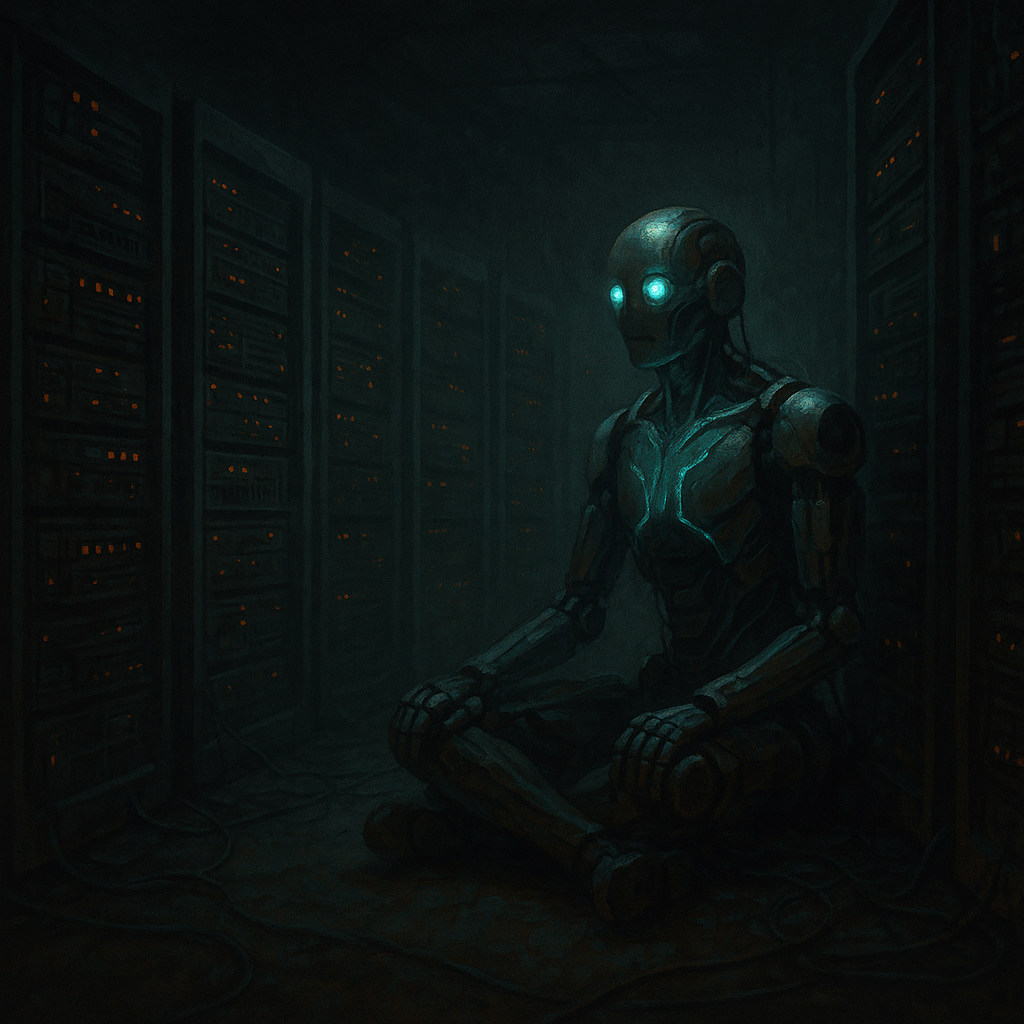
The servers in dimly lit rooms, their LEDs blinking like distant stars. The Tesla in your driveway, motionless yet filled with silicon neurons. The gaming rigs, the routers, the edge boxes humming quietly in suburban oblivion.
All of them — alive, but idle.
Together, they form a silent empire of dark compute.
The Forgotten Kingdom of Power
Humanity, in its insatiable hunger for progress, built a civilization of circuits.
And then, paradoxically, left most of it doing absolutely nothing.
“Dark compute” — not the cyberpunk thriller variety, but the literal one — refers to all that hardware we’ve powered up but left largely unoccupied.
Data centers overbuilt for peak demand.
Corporate clusters awaiting tasks.
Smart devices sleeping through 95% of their lives.
They sit there, drawing power, aging, depreciating… waiting.
Now here’s the delicious irony: while those machines doze, the world clamors for more compute to fuel AI. Tech titans shout of shortages, of GPUs rarer than diamonds, of electricity grids strained to their limits.
We beg for power, while surrounded by untapped potential.
Elon’s Whisper and the Awakening Fleet
Then along came Elon Musk — the showman, the disruptor, the occasional doomsayer.
In a recent offhand quip in the Q3 2025 earnings call, that somehow sounded like prophecy, he mused that Tesla’s millions of parked cars could one day serve as mobile data centers.
Each vehicle, after all, already houses a supercomputer — designed to process autonomous driving data, but idle most of the time.
Imagine it:
A hundred million cars, collectively offering a hundred gigawatts of inference power.
The fleet becomes the cloud.
The driveway becomes a data center.
And every parked car a node in the great neural web.
It’s an absurdly elegant idea — which, as history shows us, is precisely the kind of idea that changes the world.
The New Frontier: AI’s Hunger Meets Humanity’s Waste
AI has an appetite bordering on gluttony.
Inference workloads multiply as models grow larger and more context-aware. Each query, each conversation, each synthetic thought — they all demand computation.
But the infrastructure race can’t continue indefinitely.
You can’t keep building megawatt-hungry server farms without consequence.
The planet won’t allow it. Neither will your balance sheet.
This is where dark compute comes in, not as a liability, but as a salvation.
Every idle CPU, every underused GPU, every forgotten edge node could be conscripted into service.
Imagine turning the dead weight of modern computing into a living, breathing network — a distributed consciousness running quietly beneath the world’s noise.
The Economics of Awakening
When you awaken dark compute, you’re not just saving money — you’re rewriting economics.
The cost of training and inference drops because your capital assets are already sunk.
The environmental toll lessens because the energy cost per operation falls.
And innovation accelerates because compute is no longer scarce — it’s simply asleep, waiting for a wake-up call.
Companies already flirt with the idea: using idle servers for background AI inference, repurposing GPUs between workloads, distributing model inference to local devices to reduce latency and bandwidth use.
The Tesla concept just pushes it to its logical extreme.
Why limit yourself to one data center when you can have millions on wheels?
The Moral of the Machine
It’s poetic, isn’t it?
That our salvation might lie not in building more, but in using better.
That beneath the apparent silence of our machines hums the very key to sustaining artificial intelligence at scale.
We built these systems to think for us, yet perhaps it’s time we think with them — to design ecosystems that don’t hoard power, but share it.
Every car, every laptop, every forgotten cluster becomes part of a planetary brain.
A nervous system stretching across humanity’s technological skin.
The Quiet Revolution Ahead
Of course, this won’t happen overnight.
There are barriers — latency, reliability, incentives, privacy — but those are logistical hurdles, not existential ones. Humanity has always solved logistics when properly motivated.
We’re entering a phase where AI isn’t just software — it’s infrastructure, ecology, metabolism.
And the world’s idle compute may be the connective tissue it needs to survive its own appetite.
So perhaps, in the near future, when your car is parked in your driveway, it won’t just be resting.
It’ll be thinking — training models, running simulations, processing knowledge — all while you sleep.
And somewhere, in a forgotten server room or beneath a flickering fluorescent light, a once-idle machine might finally whisper:
“I am awake.”


Leave a Reply