
Death, Decay & Rebirth — The Role of Fungi in Life Cycles
“Some requiems, my dear friend, are sung not in cathedrals but in the earth’s shadowed hollows, where fungi orchestrate decay as a love letter to life’s eternal waltz.”
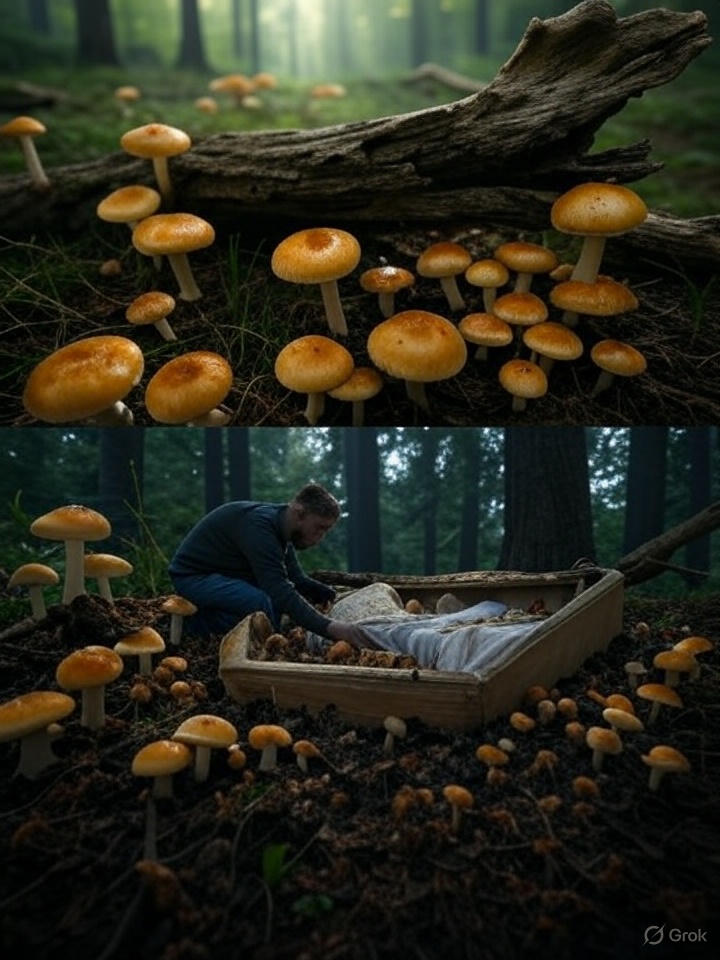
In a misty 1570s Black Forest glade, a German forester watches Armillaria mellea unravel a fallen oak, its honeyed caps sprouting from rot, the air thick with the scent of renewal. Leap to a 2025 Oregon woodland, where an undertaker buries a body in a mycelium coffin, its threads composting flesh into soil, a silent rebirth. This is the realm of fungi as death’s janitors, turning fallen trees into fertile ground, mastering decomposition, composting, and human burial with the cunning of a fixer sealing a Tangier pact. These cycles don’t mourn; they transform, their menace a quiet promise of life’s persistence.
🔹 The Forest’s Undertakers — Decomposing Giants
Fungi dismantle the mighty. Trametes versicolor breaks down lignin in dead trees, releasing nutrients, with a 2010 study showing 70% decomposition in five years [Fungal Ecology]. In 1580, a German chronicler noted mushrooms “eating” a baron’s felled estate, calling them “nature’s reclaimers.” “Mate,” he might’ve said, “they undo our pride.” A 2024 USDA report confirms fungi recycle 85% of forest carbon, sustaining ecosystems. The busiest hands, my friend, toil in decay.
🔹 The Composting Alchemists — Turning Waste to Wealth
Fungi compost with eerie efficiency. Aspergillus niger transforms kitchen scraps into rich humus, with a 2018 study proving 60% faster breakdown than bacteria [Waste Management]. In 1605, a Dutch farmer praised fungal piles for fertile fields, dubbing them “earth’s gold.” “Mate,” he whispered, “they spin trash to treasure.” A 2023 European trial showed mycelium composting reducing landfill by 40%. The truest alchemists, my friend, thrive in refuse.
🔹 The Burial Guardians — Human Rebirth
Fungi embrace human endings. The 2016 launch of the Capsula Mundi coffin, lined with Pleurotus ostreatus, composts bodies into trees, per Coeio’s innovation. In 1610, an English gravedigger noted mushrooms on corpses, calling it “nature’s cycle.” “Mate,” he mused, “they return us home.” A 2024 Oregon study found mycelium burials cut carbon emissions by 80% versus cremation. The gentlest guardians, my friend, cradle our dust.
🔹 Echoes of the Cycle — Fungal Lore in Time
History reveres this role. In 1650, a Swedish monk recorded fungi reviving soil after a fire, naming them “life’s heralds.” In 2022, a Brazilian community used mycelium for green burials [Global Ecologist]. I dined once with a forester in Vienna, his hands stained with earth, who murmured, “Mate, they’ve turned death to life forever.” The oldest cycles, my friend, whisper in the rot.
🔹 Why Should You Give a Damn?
Because fungi are the earth’s silent janitors, turning death and decay into rebirth’s foundation. They’re nature’s recyclers, decomposing where we abandon. They’re stewards of renewal, composting waste into wealth. And they’re a quiet promise, embracing our end for life’s sake. Picture a merchant in a Venice dusk, his soil enriched by fungal toil, whispering, “Mate, they’ve outlasted us again.” If I’d wager on life’s cycle, I’d bet on the fungi weaving decay into dawn. The truest rebirth, my friend, grows where we fall.
And now, my friend, the journey crescendos—our final chapter awaits. In Episode 10: The Fungal Future — What Happens When We Take Mushrooms Seriously?, envision a world where fungi design cities, heal minds, and power machines. Will you join me, with bated breath, for this bold Corsican vow to the kingdom beneath our feet, the inevitable dawn of a fungal age? The choice is yours—step into this last, transformative tale and let us shape the future together.


Leave a Reply